Zhida Plastic Machinery
Plastic plants are entering 2026 under pressure to make more parts with less energy, scrap, and unplanned downtime. That pressure is changing how teams select robots, sensors, software, and process controls. Plastic Manufacturing Automation Trends now extend beyond faster cycle times. They increasingly connect the injection press, material handling, inspection, and production data. Small changes matter. A robot that removes a hot molded part consistently can support stable cycles, while vision cameras may flag short shots or surface defects before packing. Yet automation cannot replace sound tooling, trained operators, or disciplined maintenance. That distinction is easy to miss.
Across the top trends for 2026, manufacturers are exploring AI-assisted process tuning, collaborative robots, digital twins, predictive maintenance, automated quality inspection, and connected production systems. Adoption varies by resin, part geometry, plant layout, and investment capacity. A high-volume cap manufacturer may benefit from automated takeout and packaging; a custom molder may gain more from flexible cells and quick-change tooling. The best result is measurable. Track scrap rate, energy per part, downtime, and changeover time before and after each upgrade. Test vendor claims on the actual machine and material. Data quality can disappoint, especially when older presses lack consistent signals or teams have little time to maintain dashboards. These limits matter. This guide examines ten practical developments, what they may improve, and where cautious pilots still make sense.
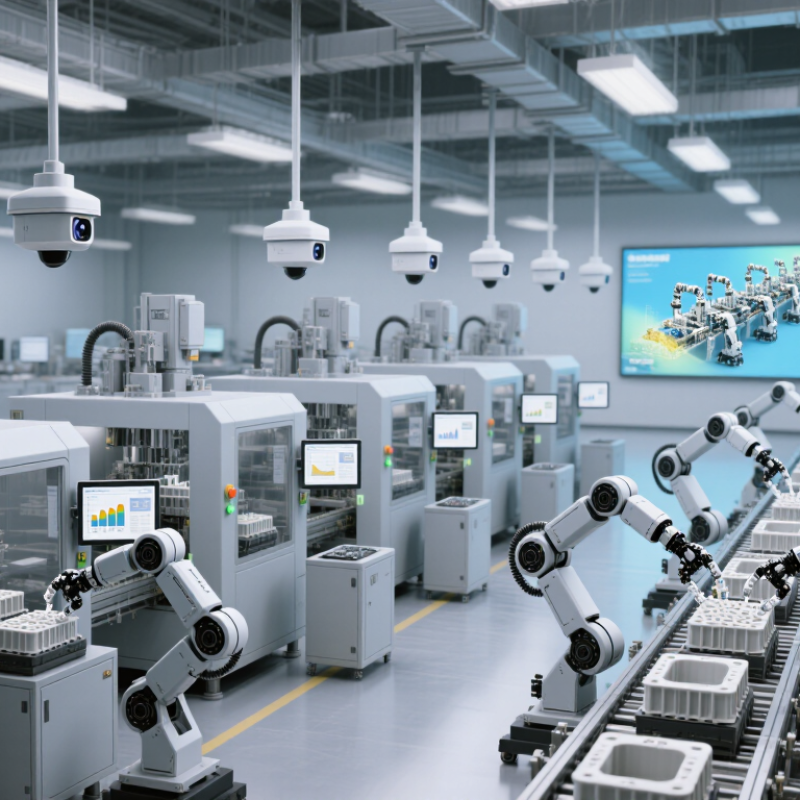
Plastic factories in 2026 are building automation on dependable data, stable controls, and connected machines. These foundations matter on the molding floor, where small changes in temperature or cycle time can affect part quality. The International Federation of Robotics reported 4.28 million industrial robots operating worldwide in 2023, up 10% from 2022 (World Robotics 2024). That figure reflects broad manufacturing, not plastics alone, but signals the growing role of robotics.
For plastics producers, automation starts with sensors that track melt temperature, pressure, cycle time, and energy use. Connecting this information to machine controls can help teams spot drift before defects pile up. Robots can handle repeatable tasks such as part removal and packing, while machine-vision checks catch visible flaws. Still, integration is rarely tidy. A disconnected sensor may create another dashboard, not a better decision. Older equipment and inconsistent data can slow progress, so upgrades need practical testing on the line.
Tips: Start with one measurable problem, such as scrap or unplanned downtime. Record a baseline, test a sensor or robotic task on one machine, then compare results across several shifts. Keep operators involved; their observations often explain what the numbers miss.
Smart molding is moving beyond fixed recipes. In 2026, connected presses can adjust clamp force, injection speed, and hold pressure using live process data. A cavity-pressure sensor, for example, can reveal when a thin section fills too slowly. The system can respond before that variation becomes a run of short shots.
Useful automation also depends on clean, consistent inputs. Resin moisture, material temperature, and screw recovery time can all shift part quality. Sensors help operators spot changes earlier, but they do not explain every cause. A blocked vent may still need a person’s attention. That detail matters.
Extrusion lines are gaining similar control. Cameras and gauges can track wall thickness, surface defects, and dimensions as profiles leave the die. Adaptive controls can then make small changes to puller speed or die temperature. Small changes count. Yet aggressive corrections may create new variation, especially during startup or material changes. Teams should validate control limits against actual production data, then review rejected parts and machine logs together. Automation can steady a process, but it cannot make a poorly understood process reliable.
Smart molding, extrusion, and adaptive process control
Adaptive process control, in-mold sensing, and inline inspection are prominent ways to improve consistency and respond to process variation. Scores are a qualitative editorial index, not measured market-share or adoption statistics.
Robotics, Machine Vision, and Automated Material Handling
Robotics is moving beyond simple pick-and-place tasks in plastic manufacturing. Robots can remove hot parts from molds, trim edges, and stack finished components, reducing repetitive handling near presses.
The International Federation of Robotics reported 4,281,585 industrial robots in operation worldwide in 2023, up 10% from 2022 (World Robotics 2024). This is a cross-industry figure, not a plastics-only measure, but it shows the expanding automation base.
That matters. Still, a robot cannot fix a poorly designed cell or inconsistent part presentation.
Machine vision helps inspect molded parts for flash, short shots, color variation, and misplaced inserts. Pairing cameras with clear lighting and repeatable inspection criteria makes defects easier to flag before packing.
Automated conveyors and guided carts can then move resin, inserts, and finished goods between work areas. Yet integration is often messier than the diagrams suggest. Reflective surfaces, dust, and changing part colors can cause missed detections, so teams should test with real production samples.
Tips:
Start with one bottleneck, such as unloading a press or checking a critical feature. Record cycle time, rejects, and stoppages before and after installation. Keep a manual fallback plan; sensors and grippers need adjustment, and not every product change will run smoothly. Review false rejects weekly, then update inspection thresholds with process and quality staff.
Across injection molding and extrusion lines, AI is becoming most useful when it spots small changes operators might miss. Models can compare melt pressure, barrel temperature, cycle time, and scrap rates across shifts. An alert may reveal a cooling problem before warped parts fill a bin. Still, sensor drift and inconsistent material batches can confuse the model. Human review matters.
Digital twins give teams a practical way to test adjustments before changing a live process. A calibrated model can show how a slower cooling cycle might affect cycle time, energy use, and part dimensions. Its value depends on accurate machine data and regular updates. A twin built from old settings can look convincing and still mislead. That limitation deserves attention.
Connected factory operations link machines, quality checks, maintenance records, and production schedules. When a press slows, operators can see whether the cause is a material change, a tool issue, or a downstream bottleneck. Shared dashboards also reduce the habit of relying on handwritten shift notes. Not every alert helps. Too many notifications can distract workers, so plants need clear thresholds and assigned follow-up. Integration takes time, and older equipment may not provide clean data. The best systems leave operators in control while making useful evidence easier to find.
In 2026, plastic manufacturers will treat energy efficiency as a production metric, not just a utility bill. The U.S. Department of Energy estimates that motor-driven systems use about 54% of electricity in U.S. manufacturing. That makes injection presses, chillers, and material-handling equipment practical places to start. Automation can track energy per kilogram of output and flag unusual idle loads. A warm barrel running through a long pause is easy to miss. The dashboard may not explain why.
Quality assurance is moving closer to the machine. Inline sensors can monitor melt temperature, pressure, cycle time, and part dimensions while production runs. Teams can link these readings to reject rates and investigate drift before a full batch is affected. But sensors need regular checks; bad readings can make a process look stable when it is not. Automation helps reveal variation. It does not remove the need for judgment.
Workforce readiness matters just as much. Deloitte and the Manufacturing Institute’s 2024 workforce study projects 3.8 million U.S. manufacturing jobs may be needed by 2033, with 1.9 million potentially unfilled. Practical training should let operators interpret alarms, verify sensor readings, and adjust approved settings. Short, hands-on sessions often fit shift work better than long classroom blocks. Still, training plans can be too optimistic: experienced staff also need time to teach.
| # | Automation Trend | Typical Application | Useful Measurement | 2026 Implementation Focus |
|---|---|---|---|---|
| 1 | Machine-level energy monitoring | Collect electricity-use data from molding, extrusion, drying, and auxiliary equipment. | Energy intensity: kWh per kilogram of good product; peak demand: kW. | Connect energy readings with machine state and production output so teams can identify avoidable idle and standby consumption. |
| 2 | Energy-aware machine and process control | Coordinate heaters, pumps, cooling, compressed air, and production schedules with actual process requirements. | Energy use per production run; idle-time energy use; energy cost per unit. | Use measured process requirements and approved operating limits to reduce unnecessary energy use without compromising part quality. |
| 3 | Closed-loop process monitoring | Use sensor feedback to monitor variables such as melt temperature, pressure, cycle time, and cooling conditions. | Process-variable deviations; cycle-time variation; first-pass yield. | Connect process data to documented recipes and alert operators when readings move outside validated limits. |
| 4 | Automated vision inspection | Inspect parts for visible defects, missing features, dimensional characteristics, or surface irregularities. | Defect detection rate; false-reject rate; inspection coverage. | Validate inspection performance against representative parts and confirm that camera-based checks complement required measurement methods. |
| 5 | Automated in-line measurement | Measure selected dimensions or characteristics during production using suitable gauges or sensors. | Measurement results against specification; measurement-system repeatability. | Prioritize characteristics that affect fit, function, safety, or downstream processing, and maintain calibration and measurement records. |
| 6 | Condition monitoring and predictive maintenance | Track equipment indicators such as vibration, temperature, pressure, and motor current. | Unplanned downtime; maintenance response time; equipment availability. | Start with critical assets and use alarm thresholds that maintenance teams can verify and act on. |
| 7 | Robotic material handling and machine tending | Automate part removal, material loading, trimming, packing, or repetitive transfers. | Manual handling steps; cycle-time consistency; task-related safety observations. | Assess guarding, risk reduction, access, and changeover needs as part of the automation design and commissioning process. |
| 8 | Production data integration and traceability | Link machine, process, inspection, material, and production records for each batch or production order. | Record completeness; time to retrieve a production history; batch-level traceability coverage. | Standardize data definitions and identifiers so information can be compared across equipment and production stages. |
| 9 | Digital models and virtual commissioning | Model equipment or production-cell behavior to test layouts, sequences, and control logic before physical changes. | Commissioning issues found before startup; line-balance assumptions; changeover time. | Keep model assumptions aligned with actual machine capabilities and validate the model against operating data. |
| 10 | Workforce readiness for automated operations | Train operators and technicians to interpret alarms, verify quality data, follow safe procedures, and support automated cells. | Training completion; demonstrated task competency; response time to defined alarms. | Pair new systems with role-based training, clear escalation steps, and operator involvement in process and safety reviews. |
Measurement note: Metrics are operational measures to track, not guaranteed results. Define each metric consistently and compare results under equivalent product, material, and production conditions. Overall equipment effectiveness (OEE), when used, is commonly calculated as Availability × Performance × Quality.
Sensors track cavity pressure, clamp force, injection speed, and hold pressure. The press can adjust settings when a thin section fills slowly. It may prevent short shots, but it cannot identify every cause.
Resin moisture, material temperature, and screw recovery time can shift results. A blocked vent may still need an operator’s attention. Sensors help, but they do not explain everything.
Cameras and gauges monitor wall thickness, surface defects, and dimensions. Controls can adjust puller speed or die temperature. Small changes matter. Aggressive corrections may create new variation.
Validate control limits with actual production data. Review rejected parts alongside machine logs. Startup and material changes deserve extra attention; they can make tidy settings less reliable.
Robots can remove hot parts, trim edges, and stack components. This reduces repetitive handling near presses. Still, poor cell design or inconsistent part placement can disrupt the work.
Cameras can flag flash, short shots, color changes, and misplaced inserts. Clear lighting and consistent inspection rules help. Reflective surfaces can still fool the system.
Choose one bottleneck, such as unloading a press or checking one critical feature. Record cycle time, rejects, and stoppages before and after installation. Start small.
Sensors and grippers may need adjustment, especially after product changes. Track false rejects weekly and review inspection thresholds with quality staff. The changeover may not go smoothly.
Plastic Manufacturing Automation Trends in 2026 reflect a shift toward connected, adaptable production systems. Automated foundations help manufacturers coordinate equipment, materials, and production data, while smarter molding and extrusion processes use real-time feedback to adjust operating conditions. These capabilities can reduce process variation, support consistent output, and make it easier to respond to changing product requirements.
Robotics and machine vision can automate repetitive handling and inspection tasks, while digital twins and connected factory operations help teams monitor performance and anticipate process issues. Energy-aware controls and stronger quality assurance further support efficient production. As automation expands, workforce readiness remains essential: employees need the skills to operate, maintain, and interpret data from these systems. Together, these developments point toward plastic manufacturing that is more precise, responsive, and resource-conscious.
